

There is a grand tradition of generation ship stories in science fiction. These narratives have a lot on the common with the city-based story in speculative and literary fiction – narratives that restrict themselves to one city and explore the various tensions within it to the point where the city itself is a character. In many generation ship stories, and British-Egyption novelist Mahmud El Sayed’s debut novel The Republic of Memory is one of these, that character is realised in the form of an AI with the same name as the giant colony ship it once controlled: Safina.
The Republic of Memory opens only a few years into the voyage of the Safina and describes a crew revolt which disconnected the AI which had decided to abandon the mission and take the ship back to Earth. The narrative then jumps forward two hundred years, halfway into the ship’s journey to the planet Hurriya, to explore the complex society that has arisen over that time. The ship is officially divided by language (although religion seems to play a big part too) but also by work status with Admin at the top and various other jobs below that in a strict hierarchy. In the bowels of the ship are thousands of cryogenically preserved bodies of the crew’s ancestors, awaiting arrival at Hurriya, when they will be revived.
The story initially focusses on a translator called Iskander Ezz whose job it is to help people navigate Admin. Iskander comes from a well-connected family and he has used that influence to free his sister Diametta from Security after she was arrested for graffiti. Diametta is part of a revolutionary movement that slowly gains traction over the course of the book, particularly after the ship is disabled by a complete power failure. El Sayed widens the narrative to range across the points of view of a number of characters as he fleshes out the different parts of the ship and its warring factions.
The Republic of Memory inexorably builds to a major confrontation between revolutionary forces seeking reform and the ruling hegemony. El Sayed brings this to life by cycling through the views of characters on both sides of the conflict and those caught in the middle. One of the ways El Sayed, a linguist, brings the disconnect to life is through the polyglot pigeon language of the revolutionaries that draws from a range of languages and slang, an approach similar to that taken by James SA Corey with Belter in The Expanse series.
The Republic of Memory is a great example of why science fiction writers keep coming back to the generation ship as a setting. It allows them to hypothecate new societies and political movements but to confine them all to a completely sealed environment. There is the optimism that lies at the end of the generations-long journey but also the realism of those on board who know that this future is not for them but for their descendants. And being a ship, there are built-in hierarchies of control from the Captain down. El Sayed manages to throw a few new fascinating wrinkles into this mix along with leaning into a kind of pan-Asian futurism to drive his narrative, an aspect which provides yet another layer to his narrative.
Just be warned though –The Republic of Memory is the first book in a series. After much build up it ends with much in flux and several cliffhangers for main characters. El Sayed has done more than enough though to ensure readers will be back for the next instalment.
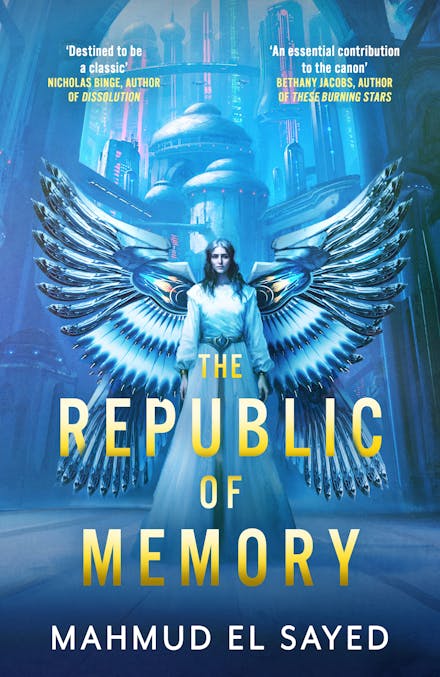
The Republic of Memory by Mahmud El Sayed
No Comments